What do ACH return codes mean, and which ones cost you most?
Risk
November 5, 2026
|
Aeropay Team

This article was written by the payments nerds at Aeropay. Our goal is to provide you with solid insights to help your business operationalize more efficient, value-focused payments.
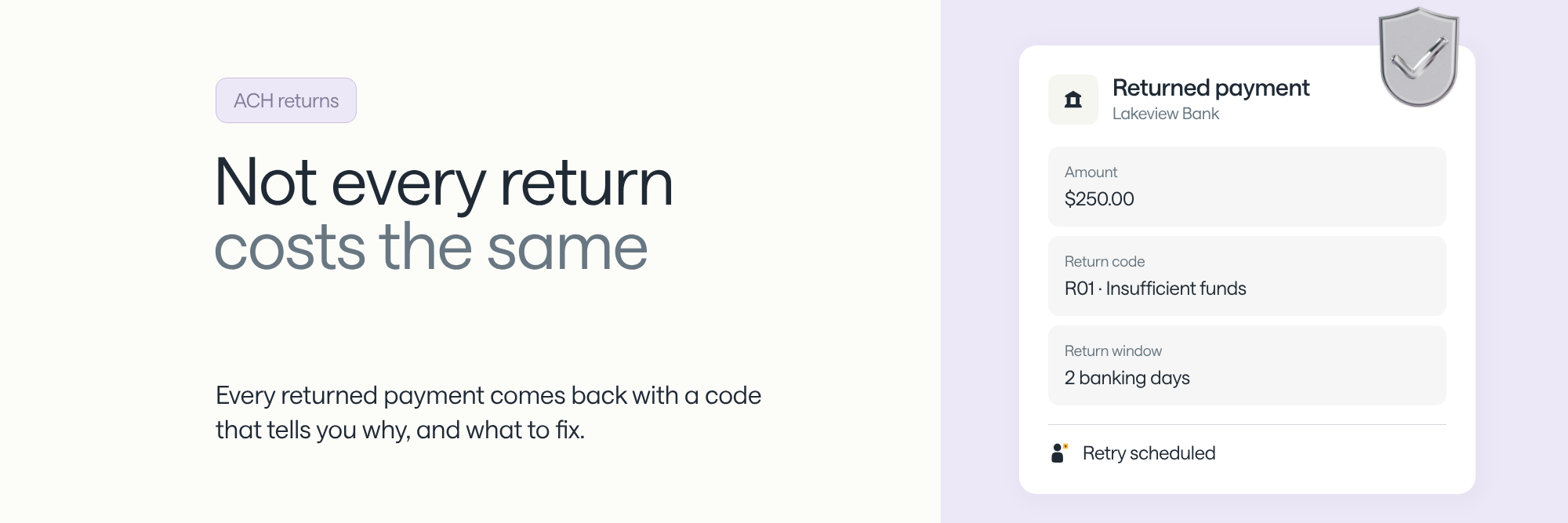
An ACH return code is the reason a customer's bank gives, such as R01 or R10, for sending an ACH payment back unpaid. It says why the payment failed and sets the bank's deadline to return it. Unauthorized returns cost US businesses the most, because they can arrive up to 60 days after settlement and can't be retried.
Return codes are set by the Nacha Operating Rules, which govern the US ACH network. The customer's bank, called the RDFI (receiving depository financial institution), picks the code, and your payment provider passes it back to you. Read the code before anyone works a failed payment, because it tells you whether the problem is money, account details or a dispute.
Twelve codes cover the returns US businesses see most often. They fall into three groups, and each group needs a different fix.
| Code | Meaning | Group | Deadline to return (after settlement) | Nacha threshold it counts toward |
|---|---|---|---|---|
| R01 | Insufficient funds | Funding | 2 banking days | Overall (15%) |
| R09 | Uncollected funds | Funding | 2 banking days | Overall (15%) |
| R02 | Account closed | Account | 2 banking days | Administrative (3%) |
| R03 | No account, or unable to locate account | Account | 2 banking days | Administrative (3%) |
| R04 | Invalid account number structure | Account | 2 banking days | Administrative (3%) |
| R16 | Account frozen | Account | 2 banking days | Overall (15%) |
| R05 | Unauthorized debit to a consumer account using a business entry code | Authorization | 60 calendar days | Unauthorized (0.5%) |
| R07 | Authorization revoked by customer | Authorization | 60 calendar days | Unauthorized (0.5%) |
| R08 | Payment stopped | Authorization | 2 banking days | Overall (15%) |
| R10 | Customer advises the payment was not authorized or the originator is unknown | Authorization | 60 calendar days | Unauthorized (0.5%) |
| R11 | Customer advises the payment didn't match the terms of their authorization | Authorization | 60 calendar days | Unauthorized (0.5%) |
| R29 | Business customer advises the payment was not authorized | Authorization | 2 banking days | Unauthorized (0.5%) |
Every code also counts toward Nacha's 15% overall return threshold. The 60-day deadline applies to consumer accounts, so an unauthorized return can arrive weeks after you've shipped the order, credited a wallet or paid out funds.
Unauthorized returns cost the most, account data returns come second, and funding returns cost the least. Three things set that order: how late the return arrives, whether you can recover the money, and how strictly Nacha caps it.
Nacha also caps all returns combined at 15% of debits, according to its Risk and Quality Rules fact sheet. The thresholds measure your business as the originator, so every return you prevent counts toward staying under all three.
Each group points to a different broken step, so sort your returns by group before you change anything.
For a broader playbook on preventing returns, see ACH returns: How to stop failed bank payments.
Two banking days after settlement for most returns. Unauthorized returns on consumer accounts, such as R10 and R11, have a 60-calendar-day deadline. Business accounts get no extended window: an unauthorized return on one comes back as R29 within two banking days.
A return code means the payment failed and the money came back. A notification of change, which uses C codes like C01, means the payment posted but the bank corrected the account details. In most cases, Nacha requires you to update the details within six banking days or before your next payment, whichever is later.
Not by sending the payment again. For a consumer account, your bank can request the customer's written statement of unauthorized debit, and the customer's bank must provide it within 10 banking days. If the authorization holds up, you resolve the dispute with the customer directly, outside the ACH network.
ACH return codes tell you why a payment failed and how to stop it happening again. Funding returns are the easiest to recover, account data returns point to unverified accounts, and unauthorized returns cost the most because they arrive late and can't be retried. Verify accounts when customers connect them and check risk before settlement to cut all three.
Want fewer returns, and coverage on the ones that still happen? See how Aeropay Guaranteed ACH covers eligible returns, up to your agreed coverage limit.