How do high-risk merchants get approved for ACH and pay by bank?
Risk
November 23, 2026
|
Aeropay Team

This article was written by the payments nerds at Aeropay. Our goal is to provide you with solid insights to help your business operationalize more efficient, value-focused payments.
If a card processor has labeled your business high-risk, you've probably faced higher rates, rolling reserves or a closed account with little warning. ACH and pay by bank are the usual next step, but bank payment providers underwrite merchants too, and approval depends on what you bring to the application.
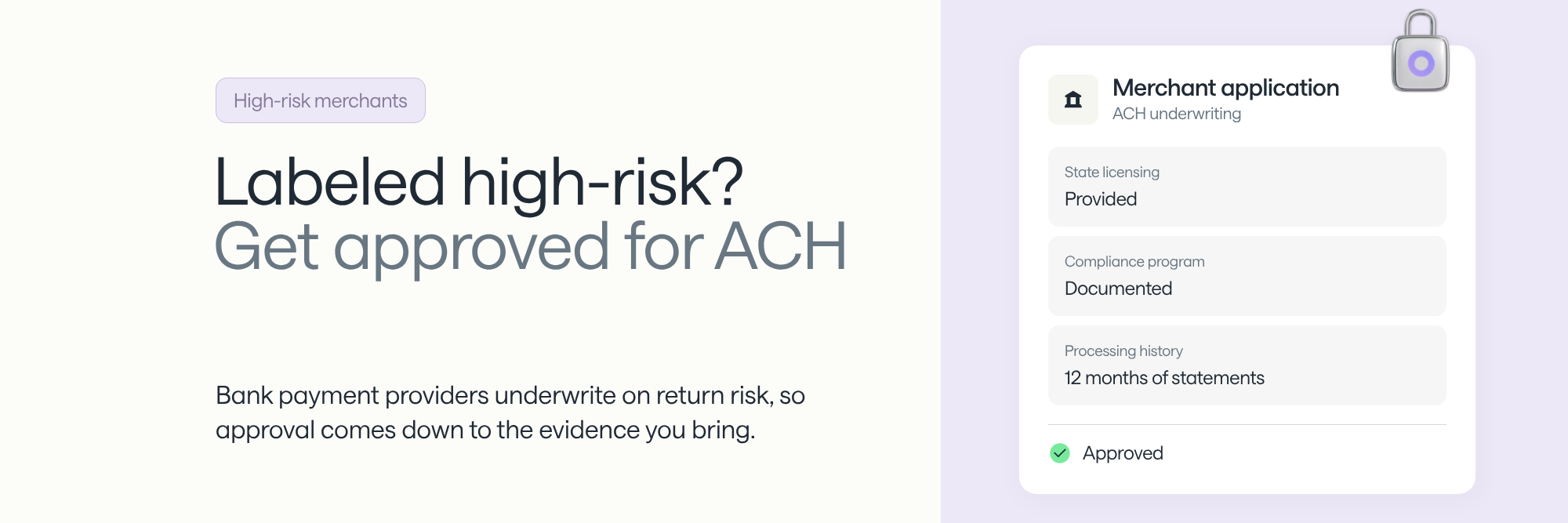
Many US high-risk merchants can get approved for ACH and pay by bank, because bank payments carry no card-network chargebacks and providers underwrite them on return risk instead. Approval depends on state licensing, a documented compliance program, processing history and fraud controls, and merchants who bring that evidence to the application are the most likely to be approved.
Card processors usually apply the high-risk label because of a merchant's industry, chargeback exposure, volume pattern or short processing history. Why that happens, and how moving volume to bank payments changes chargeback exposure, is covered in our guide to how high-risk merchants reduce chargebacks when card processors say no. The rest of this guide covers what an ACH provider reviews, how to prepare the application and what terms come with an approval.
ACH providers underwrite a high-risk merchant on legal exposure and return risk, so they review the same seven areas before approving a single payment.
A strong application answers an underwriter's questions before they're asked. Assemble these six items before you contact a provider.
An ACH approval for a high-risk merchant often comes with conditions that limit the provider's exposure to returns. The usual ones are a reserve held against future returns, a cap on daily or per-payment volume, and a ramp that raises those caps as the merchant builds a clean return history.
Which conditions you get depends on who carries the return risk. When the merchant carries it, the provider relies on reserves and caps to cover returns that come back after funds have moved. When the provider guarantees returns, the coverage terms decide how much protection the merchant has. Aeropay Guaranteed ACH covers eligible bank-initiated returns, across 50+ return types including insufficient funds, up to the merchant's agreed coverage limit. Before you sign, ask any provider which return types its guarantee covers, what the limit is and which payments sit outside it.
Fraud controls shape these terms too. We built our risk model in regulated industries such as gaming, and Aeropay Guard scores each pay by bank transaction in real time to predict fraud and return risk before funds move. Transaction-level scoring is the kind of control an underwriter looks for before raising a volume cap.
ACH approval for a high-risk merchant takes as long as the provider needs to verify licensing, compliance and processing history. A complete application, with state licenses, a written compliance policy and recent statements, moves faster than one the underwriter has to send back for missing documents.
ACH approval is easier for many high-risk merchants than card processing, because bank payments have no card-network chargebacks, the main reason card processors decline them. ACH providers still underwrite licensing, compliance and return risk, so a merchant with a high unauthorized return rate faces the same scrutiny on bank payments.
High-risk merchants often pay more for ACH, through higher pricing, a reserve or both. The deciding factor is how much return risk the provider carries, so a clean return history, account verification and fraud monitoring are the most direct ways to bring those terms down.
A new high-risk business can get approved for ACH, but without statements to show, the provider leans harder on licensing, the compliance program and fraud controls. Expect tighter starting terms, such as lower volume caps, that loosen as the business builds a clean return history.
High-risk merchants can get approved for ACH and pay by bank because bank payments are underwritten on return risk, not card-network chargebacks. Approval still depends on state licensing, a documented compliance program, honest processing history and working fraud controls. Bring that evidence to the application, and ask every provider who carries return risk, because the answer shapes your reserve, volume caps and pricing.
Turned down by card processors? See how Aeropay Pay helps regulated US businesses accept bank payments.