How do you evaluate a bank connectivity provider?
Data
November 11, 2026
|
Aeropay Team

This article was written by the payments nerds at Aeropay. Our goal is to provide you with solid insights to help your business operationalize more efficient, value-focused payments.
Bank connectivity is the step where a customer links their bank account to your app or checkout. When it breaks, sign-ups stall and payments fail weeks later. Choosing a US provider on its headline bank count misses most of what decides whether that step works.
Score a US bank connectivity provider on six things. Check how many of your customers' banks it connects, how many customers finish linking, how often connections break, and what data it returns. Then check how it verifies accounts when a direct connection fails, and whether the same connection runs payments and risk checks. Test the finalists on your own customers before you sign.
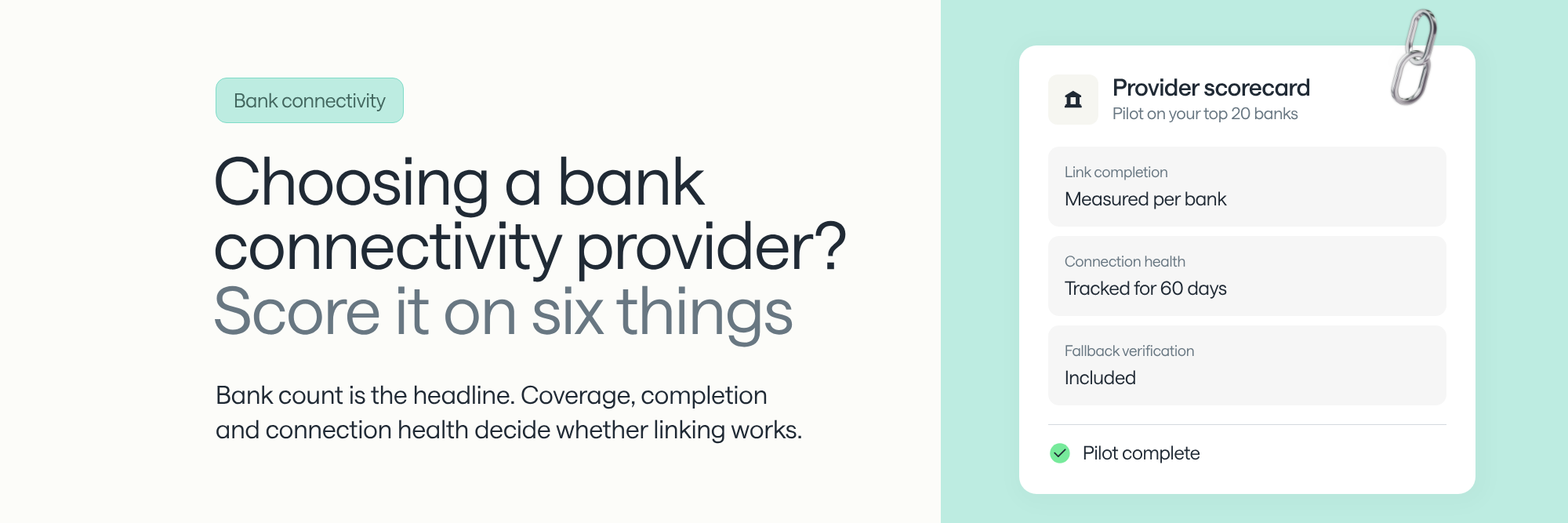
A useful scorecard puts the same six questions to every provider and judges the answers against your own customers' banks.
Weak coverage and weak fallback verification show up later as returns. Under Nacha's ACH Network Risk and Enforcement rules, debits returned for account data errors (R02, R03 and R04) count toward a 3.0% administrative return rate level, and an originator above it can face a Nacha inquiry. A provider that verifies accounts poorly pushes a business toward that level. For more on criteria 1 and 5, including how to compare owner-name match rates, see What is real-time bank account verification?
Run a pilot on your own traffic, because a provider's published averages don't reflect the banks your customers use.
One provider for both removes a hand-off. The account that's verified is the one that's debited, the balance check runs right before the payment, and risk scoring uses the connection data directly.
We built Aerosync, Aeropay's bank connectivity, after running into the limits of existing aggregators, so it was designed for companies that move money. Users link and verify a bank account in under 10 seconds with Aerosync, and Aeropay's network connects to more than 12,000 US banks and credit unions. Customers log in directly with their bank, and the bank issues a secure token, so no passwords are shared with Aeropay.
A standalone aggregator still fits a business that wants to keep its current payment processor. How to choose a pay by bank provider in the US compares the three provider models in detail.
Bank link conversion is the share of customers who complete a bank link out of those who open the linking flow. Measure it per bank and per device. Count a link as complete only when the account is verified, because a finished login with a failed verification still loses the payment.
Bank connections break when the bank expires the access token, the customer changes their password or revokes access, or the bank's connection goes down. Ask each provider how it detects a broken connection and whether customers can reconnect without linking from scratch.
Product, payments and risk teams should score a bank connectivity provider together, since each owns part of the scorecard. Product owns link conversion, and payments owns coverage and first-payment success. Risk owns the data returned and how accounts get verified when a direct connection fails.
The best bank connectivity provider is the one that connects your customers' banks, keeps them connected and verifies the accounts it can't reach directly. Judge it with a pilot on your own traffic rather than a headline bank count.
Test bank linking against your customers' banks. See how Aerosync connects US bank accounts