How much do pay by bank providers charge per transaction?
Payments
November 10, 2026
|
Aeropay Team

This article was written by the payments nerds at Aeropay. Our goal is to provide you with solid insights to help your business operationalize more efficient, value-focused payments.
Pay by bank quotes rarely line up. One provider quotes a flat fee, another a percentage, a third a percentage with a cap, and fees for returns, verification and payouts often sit outside the headline rate.
US pay by bank providers typically charge 1% to 1.5% per transaction, sometimes with a flat fee of $0.15 to $0.25 on top. Some charge a flat fee per payment or cap the percentage instead, so the cheapest model depends on your average payment size. Fees for returns, verification, faster settlement and payouts are often charged separately.
For how those rates compare with card fees, see Pay by bank vs. credit cards: which costs merchants less?
Pay by bank providers price each payment in one of four ways, and each model favors a different order size.
| Model | How it works | Best for | Watch out for |
|---|---|---|---|
| Flat fee | The same fee on every payment, whatever its size | Large average payments, such as account funding or high-ticket orders | Expensive relative to small payments |
| Percentage | A share of each payment, like card pricing | Small, frequent payments | Costs climb quickly on large payments |
| Capped percentage | A percentage up to a maximum fee per payment | Mixed order sizes | Where the cap sits, and whether it applies to every payment type |
| Percentage plus fixed fee | A percentage plus a per-transaction amount | Platforms with mid-size payments | The fixed part dominates on small orders |
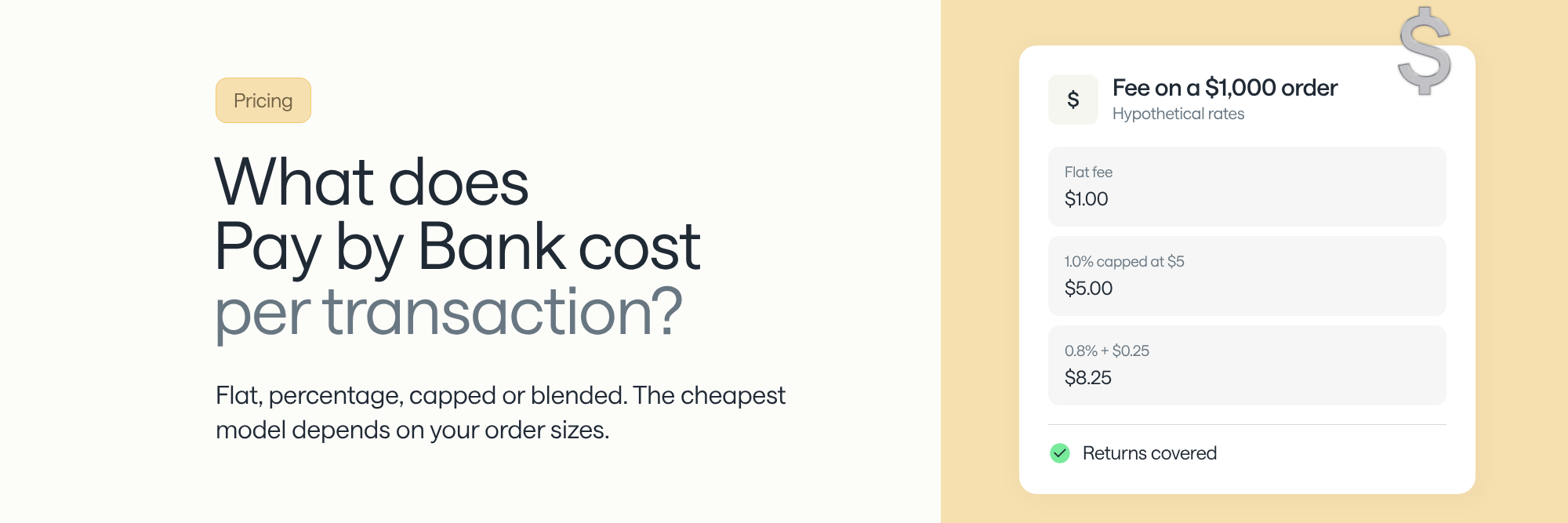
No model is cheapest at every order size. The rates below are hypothetical, chosen only to show how each model behaves, and are not any provider's prices.
| Order size | Flat $1.00 | 1.0% | 1.0% capped at $5 | 0.8% + $0.25 |
|---|---|---|---|---|
| $25 | $1.00 | $0.25 | $0.25 | $0.45 |
| $150 | $1.00 | $1.50 | $1.50 | $1.45 |
| $1,000 | $1.00 | $10.00 | $5.00 | $8.25 |
A percentage fee wins on small orders, and a flat fee or a cap wins on large ones. Run your own order-size mix through each quote before you compare headline rates.
Most of the difference between two quotes sits in fees the headline rate leaves out. Ask every provider for each of these in writing:
Put every quote through the same four steps, because the lowest headline rate is often not the lowest total cost.
Step 4 is where the biggest gaps open. A provider that charges a little more but covers returns can cost far less than one with a low rate that leaves you holding every return. We built Aeropay Guaranteed ACH for this: it covers eligible bank-initiated returns, across 50+ return types including insufficient funds, up to the merchant's agreed coverage limit.
For the full total-cost view in an online store, see What's the cheapest way for an e-commerce store to accept bank payments? For the wider provider evaluation, see How to choose a pay by bank provider in the US.
Moving a payment over ACH costs a provider about the same whether it's $20 or $2,000, so a flat fee tracks the provider's own cost. A flat fee suits businesses with large average payments, such as account funding or high-ticket orders, where a percentage fee would grow with every dollar.
Most pay by bank providers charge the business, not the customer, so the customer pays nothing to choose a bank payment at checkout. Ask each provider in writing whether any fee is ever passed to payers, such as a charge for instant withdrawals or refunds.
Verification is sometimes charged separately. Some providers bundle bank linking and verification into the per-transaction rate, and others charge per linked account. Micro-deposit verification adds its own cost: two test deposits per account, plus a wait of a day or more before the first payment can go through.
US pay by bank providers typically charge 1% to 1.5% per transaction, sometimes plus $0.15 to $0.25, through flat, percentage, capped or blended models. Which model is cheapest depends on your order sizes. Price each quote on your real order mix, add every outside fee, and subtract the returns the provider covers. That total is what pay by bank costs you.
Want to see what pay by bank would cost on your order mix? Run your volume through our savings calculator.