ACH vs. RTP vs. FedNow: which rail should each payment use?
Payments
October 21, 2026
|
Aeropay Team

This article was written by the payments nerds at Aeropay. Our goal is to provide you with solid insights to help your business operationalize more efficient, value-focused payments.
In the US, use ACH to pull money from a customer’s account, and RTP or FedNow to push money out when it has to arrive in seconds. RTP and FedNow settle at any hour but only carry payments the sender starts, so they can’t debit a customer at checkout. Same Day ACH sits between the two: it pulls or pushes, settles three times each business day and carries payments up to $1 million.
Most businesses that pay customers and get paid by them end up on two rails, ACH for money coming in and a real-time rail for money going out.
The rails differ most on direction, settlement time and whether a payment can come back.
Same Day ACH settlement times are from the Federal Reserve’s FedACH processing schedule. Network limits are from Nacha: RTP raised its limit to $10 million in June 2025 and FedNow did the same in November 2025.
Same Day ACH is an ACH payment set to settle on the business day it’s submitted instead of the next one. Settlement runs at 1:00 p.m., 5:00 p.m. and 6:00 p.m. ET, so a debit submitted by mid-morning settles that afternoon.
The limit decides which payments qualify. Same Day ACH carries payments up to $1 million each, and Nacha says the ACH operators assign next-day settlement to anything above it. That ceiling rises to $10 million on September 17, 2027, under a rule change Nacha’s members approved in April 2026.
Faster settlement moves the return clock forward too. Because a Same Day ACH debit settles a day sooner, the deadline for the customer’s bank to return it also comes a day sooner. A merchant learns about an insufficient-funds debit a day earlier than it would on standard ACH, which shortens the window in which goods or account credit are out before a failure is known.
The business-day calendar stays the same. A debit submitted Friday evening still waits for Monday.
Bank payments through Aeropay settle the same day or faster.
Both networks carry only credit transfers, which the payer’s own bank sends. A merchant can’t reach into a customer’s account over RTP or FedNow the way an ACH debit does, so checkout and subscription billing still run on ACH. Our explainer on ACH debit vs. ACH credit covers how push and pull work inside ACH itself.
The workaround is a Request for Payment. The merchant sends a request that appears in the customer’s banking app, and the customer approves a real-time payment back. It works only at banks that support Request for Payment, and the customer has to act on each request, which suits one-off payments better than recurring bills.
Real-time payments are also final. Neither network lets a sender reverse a completed payment. The sender’s bank can send a request for return, and the recipient’s bank can decline it, so a payout sent to the wrong account usually has to be recovered from the recipient directly.
The deciding question is who starts the payment, and after that, how fast it has to land.
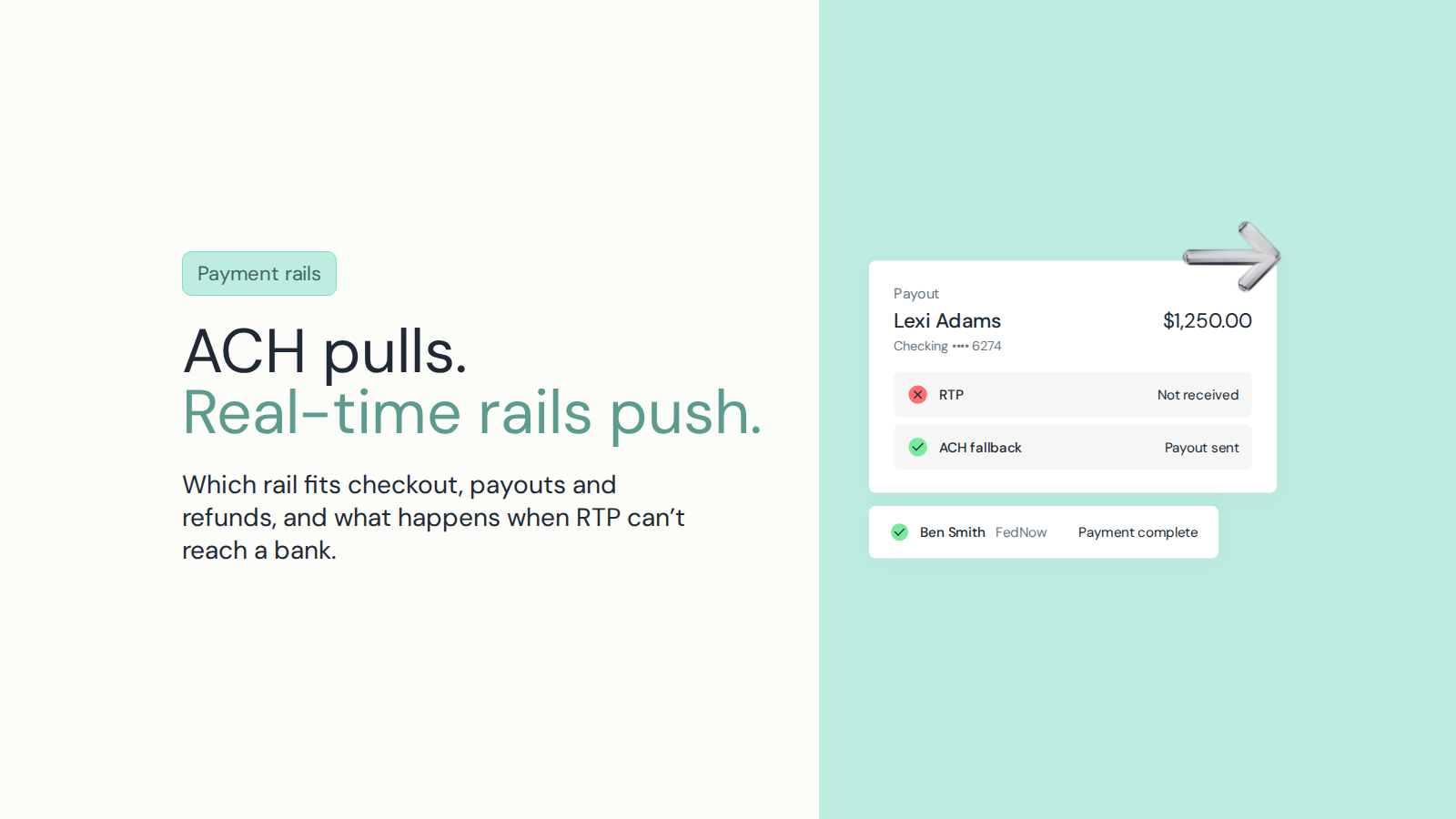
The payment should fall back to ACH automatically, so the recipient still gets paid on the ACH timeline. Mastercard puts RTP’s 2026 reach at just over 74% of US demand deposit accounts, which leaves roughly one in four that RTP alone can’t pay.
We built Aeropay Payouts, our instant payout product, around that gap. Aeropay routes payouts over RTP or FedNow first and falls back to ACH when the recipient’s bank can’t receive a real-time payment. That includes banks listed as RTP-enabled that still fail to receive, which we see in practice, so the switch has to trigger on a failed attempt. Every payout’s status shows in real time through webhooks and the Aeropay merchant portal, so the business can tell a recipient which rail carried their money.
Our guide to what a bank payment API needs to handle both pay-ins and payouts covers the questions to ask a provider about fallback and status updates.
No. RTP is run by The Clearing House, a bank-owned company, and FedNow by the Federal Reserve. Both settle credit transfers in seconds, 24/7, but a bank can join one, both or neither, so a payout provider needs access to both to reach the most recipients.
No. ACH remains the only US bank-to-bank network that lets a business pull a payment from a customer’s account on a schedule, which bill pay and subscriptions depend on. Real-time rails are taking over payouts and urgent transfers, where speed matters more than the ability to debit.
Yes. A typical setup pulls deposits by ACH and pays withdrawals over RTP or FedNow from the same linked bank account. The provider routes each payment to the rail that fits, and the customer sees one bank connection.
The Federal Reserve’s same-day submission deadlines are 10:30 a.m., 2:45 p.m. and 4:45 p.m. ET. Each bank sets its own cutoff earlier than those, so ask your bank or provider for its deadline.
Book a call to see how Aeropay Payouts would route your withdrawals across RTP, FedNow and ACH.