Can bank data verify income for thin-file borrowers?
Data
November 1, 2026
|
Aeropay Team

This article was written by the payments nerds at Aeropay. Our goal is to provide you with solid insights to help your business operationalize more efficient, value-focused payments.
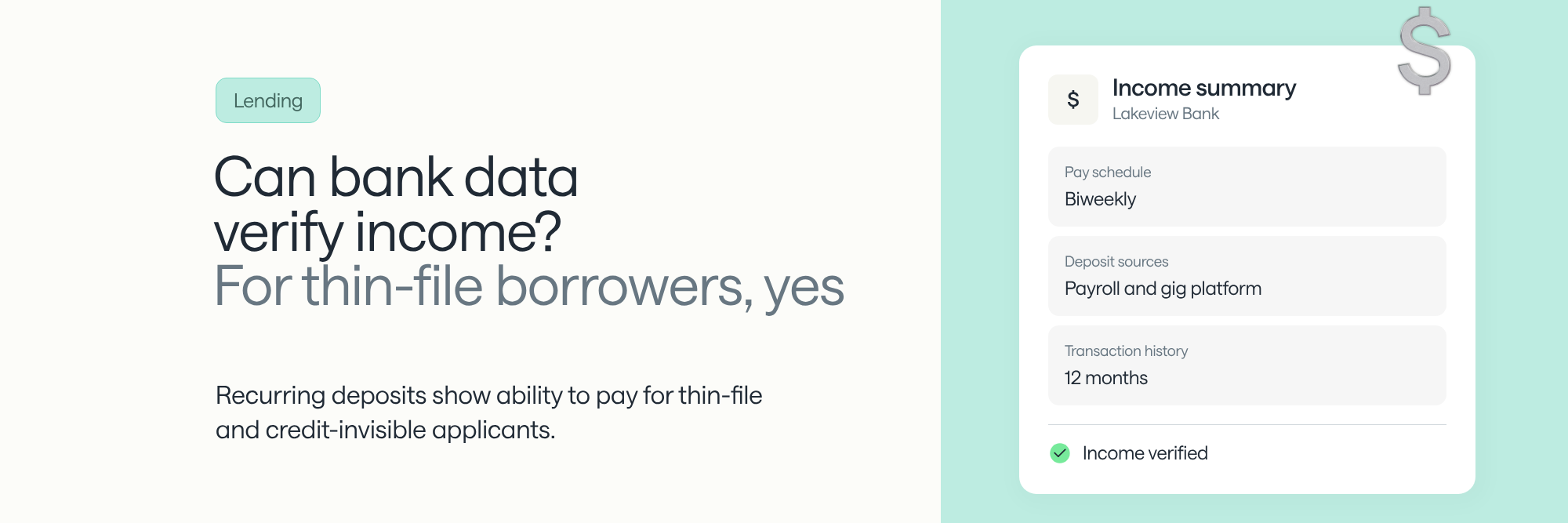
Bank transaction data can verify income for borrowers a credit score can't see, because it shows the recurring deposits that land in their account. A credit score summarizes how someone has handled credit, so it says little about someone who hasn't used much of it, such as a recent graduate, a new arrival to the US or a gig worker paid through several apps. For these thin-file and credit-invisible applicants, the deposits that arrive and the bills that go out are the clearest evidence of ability to pay.
This article is general information, not legal or credit advice.
Yes, with the borrower's permission. Bank transaction data shows recurring deposits from employers, gig platforms and benefits, which lenders use to estimate income and its stability. It's most useful for thin-file applicants, and it needs consistent categorization, a clear consent process and review under fair lending and credit reporting rules.
The CFPB estimated in 2015 that about 26 million US adults were "credit invisible," with no credit record at a nationwide credit bureau, and millions more had files too thin to score, according to its Data Point: Credit Invisibles. Traditional scores can't distinguish a responsible thin-file applicant from a risky one. Bank data adds the evidence the score is missing.
Accuracy depends less on the raw data than on how it's processed, and it comes down to coverage, categorization and history length.
Lenders should validate any model on their own applicants before relying on it.
Neither replaces the other. A credit score reflects how someone has used credit in the past, while bank data shows their current income, spending and cash cushion. Many lenders use both and lean on bank data where the credit file is too thin to score.
Yes, by identifying recurring deposits from gig and payment platforms. Gig income arrives at irregular times and in irregular amounts, so history length matters more than it does for salaried pay. Several months of deposits shows whether earnings are steady enough to support a repayment schedule.
No. Cash income only shows up if the borrower deposits it into a linked account. For applicants with cash-heavy income, such as tipped workers, lenders should ask about other accounts and consider documents alongside bank data.
No. Sharing bank data should be optional and consent-based. Lenders should explain what data they collect, why and for how long, and let borrowers choose which accounts to link. Applicants who decline should still have a way to apply.
Yes. Bank data shows the recurring deposits, expenses and cash cushion that a credit score can't, which lets lenders verify income for thin-file borrowers. Its accuracy depends on account coverage, categorization and history length. Its use depends on clear consent and a careful FCRA and fair lending review. Used well, it helps lenders say yes to applicants a score alone would miss.
Aerosync, our bank-linking product, retrieves balance, identity and cash-flow data from more than 12,000 US banks and credit unions, with up to 24 months of transaction history depending on the institution. Its deposit history shows whether a borrower is paid weekly, biweekly or monthly, so lenders can schedule repayments for just after payday. We supply the data, and the lender makes the decision.
Need permissioned bank data for underwriting? See how Aerosync links and verifies US bank accounts in under 10 seconds.