How do open banking, bank connectivity and pay by bank fit together?
Data
November 16, 2026
|
Aeropay Team

This article was written by the payments nerds at Aeropay. Our goal is to provide you with solid insights to help your business operationalize more efficient, value-focused payments.
Open banking, bank connectivity, account-to-account payments, pay by bank: the terms get used as if they mean the same thing. They don't. Mixing them up leads to buying the wrong product, such as a data provider when you needed a way to accept payments, or a payment button when you needed verified account data.
This guide untangles the vocabulary for US businesses and shows how the layers stack.
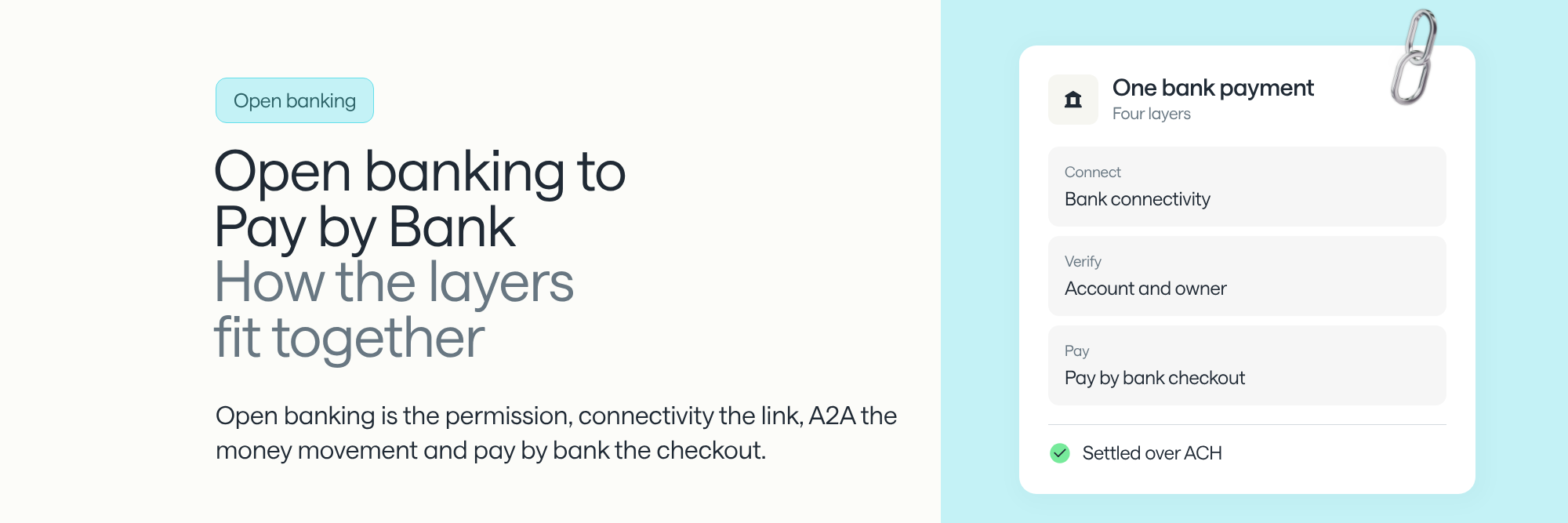
Open banking is the principle that customers can share their bank data with apps they choose. Bank connectivity is the technology that makes the connection. Pay by bank is a checkout experience built on that connection, and A2A payments are the bank-to-bank money movement underneath. In the US, each is a separate layer, and a provider may offer one or several.
In Europe, regulation came first. In the UK, the Competition and Markets Authority's 2017 order required the nine largest banks to open up customer data through common, secure standards. In the EU, the revised Payment Services Directive (PSD2), adopted in 2015, created licensed account information and payment initiation services that work through access to bank accounts. As a result, open banking payments developed there as a regulated category.
The US took a different path. Connectivity grew through private agreements between banks and data providers, and industry standards such as those from the Financial Data Exchange (FDX). The CFPB's personal financial data rights rule, known as Section 1033, would formalize access, but as of mid-2026 it was enjoined and under CFPB reconsideration, according to the Open Banking Tracker.
The practical result: in the US, "open banking" usually describes data access, while payments still run on existing rails like ACH and real-time networks. That's why US pay by bank combines a bank connection with a payment rail, rather than calling a bank payment API directly as in the UK.
For the payment-rail layer, see ACH vs. RTP vs. FedNow: which rail should each payment use? For what open banking means for money movement, see How open banking payments are reinventing money movement in the United States.
No. Open banking is about sharing bank data. Pay by bank is a checkout experience that uses a bank connection to start a payment.
Yes, though it is driven by private agreements and industry standards rather than a single mandate. The CFPB's 1033 rule would add federal requirements but was enjoined and under reconsideration as of mid-2026, according to the Open Banking Tracker.
It's an interface a bank provides so that permitted apps can access account data, or in some markets start payments, without screen scraping.
No. Pay by bank is the experience the customer sees at checkout. A2A is the money movement underneath, over ACH or a real-time rail like RTP or FedNow.
Open banking is the permission, bank connectivity is the connection, A2A payments are the money movement, and pay by bank is what the customer sees at checkout. In the US these are separate layers, so the right provider depends on whether you need data, payments or both.
Need bank connectivity and payments on one platform? See how Aeropay helps US businesses connect, verify and pay.