How do you raise pay by bank approval rates for returning customers?
Payments
November 3, 2026
|
Aeropay Team

This article was written by the payments nerds at Aeropay. Our goal is to provide you with solid insights to help your business operationalize more efficient, value-focused payments.
A customer's first pay by bank payment is the hardest one. They have to link their bank, the account is new to you, and your risk checks have the least to go on. Every payment after that should be easier, faster and more likely to be approved. In practice, many businesses treat the tenth payment exactly like the first, and lose repeat customers to friction they didn't need.
This guide explains how to turn a returning customer's history into faster checkout and higher approval rates, without loosening the controls that stop returns.
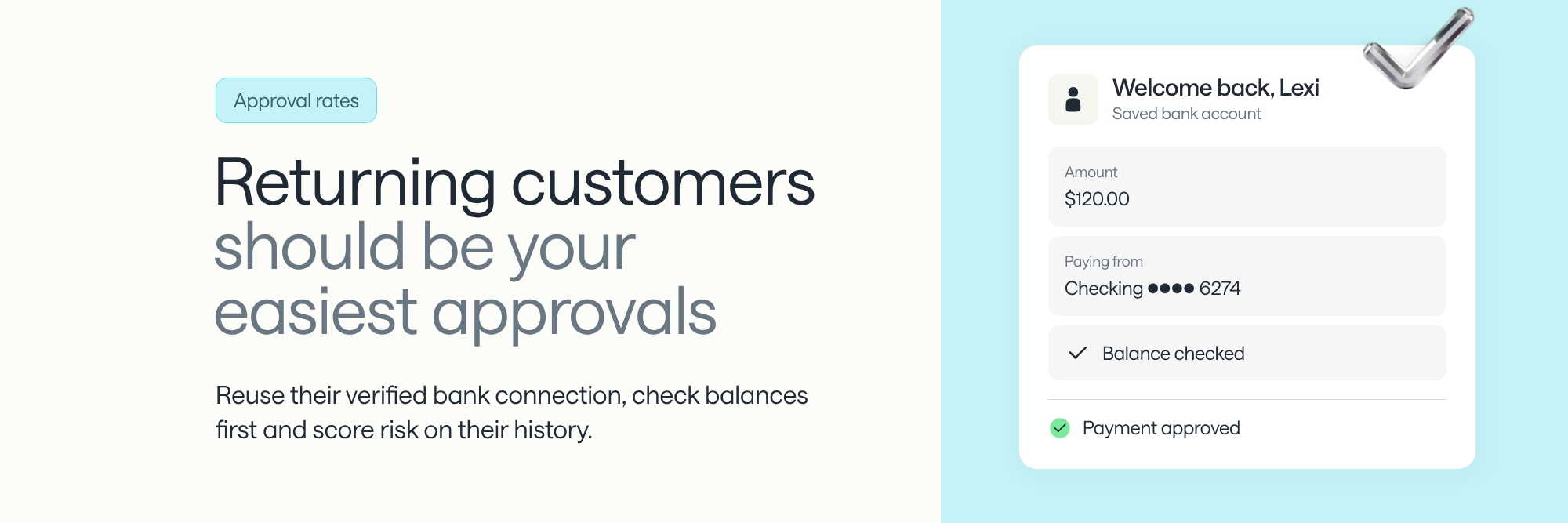
Raise pay by bank approval rates for returning customers by reusing their verified bank connection so they pay in one step, checking the live balance before each payment, scoring risk using their payment history so trusted customers are approved faster, and retrying failed payments when funds are likely to be available. Strict checks stay in place for new or unusual payments.
For how approval rates work in general, see An inside look at pay by bank approval rates.
| Lever | What it does | Effect on approvals | Effect on returns |
|---|---|---|---|
| 1. One-step repeat checkout | Reuses the stored, verified bank token so the customer doesn't re-link | Fewer abandoned payments | Neutral; the account is already verified |
| 2. Real-time balance checks | Confirms funds before each payment is submitted | Approvals based on funds actually in the account | Fewer insufficient-funds returns |
| 3. History-aware risk scoring | Uses the customer's track record, so trusted customers face less friction | More good payments approved | Risk stays controlled for new or unusual activity |
| 4. Smart retries | Retries failed payments when funds are likely to have arrived, within Nacha's limits | Recovers payments that would otherwise be lost | Fewer repeat failures than fixed retries |
One-step checkout works best when recognition extends beyond a single merchant. Aeropay recognizes returning users, including anyone who has already paid an Aeropay merchant, so they can pay without linking a bank again. Cross-merchant usage on Aeropay's network grew 31% over the past year. When a connection does expire, a reconnection flow should restore it without making the customer link from scratch.
Retries have a hard ceiling. Under Subsection 2.13.4 of the Nacha Operating Rules, a payment returned for insufficient or uncollected funds (R01 or R09) can be retried up to two times, within 180 days of the original payment's settlement date. For more on recovery, see How do you recover a failed bank payment?
Approving more from returning customers means separating trusted behavior from risky behavior and keeping a guardrail on each. Keep these in place:
The fastest providers keep bank connections alive between payments and recognize customers across their network, so a returning customer pays without linking again. When comparing providers, ask whether recognition works across merchants, how expired connections are restored, and whether balances are checked before a payment is submitted.
A good repeat approval rate is clearly higher than your first-payment rate, because returning customers have a verified account and a payment history. If repeat approvals aren't clearly higher, check broken bank connections and payments submitted without a balance check first.
No, as long as the provider keeps the verified connection alive between payments. Re-linking should only be needed when a connection breaks or the customer changes accounts, and a good reconnection flow restores a broken connection without starting over.
Reuse their verified bank connection, check balances before each payment, score risk on their history, and retry failures when funds are likely to be there. Repeat approval rates rise and checkout gets faster, while new or unusual payments still get strict checks.
Want faster checkout for your best customers? See how Aeropay helps US businesses approve trusted customers with less friction.