How fast do bank payments reach a business account?
Payments
November 17, 2026
|
Aeropay Team

This article was written by the payments nerds at Aeropay. Our goal is to provide you with solid insights to help your business operationalize more efficient, value-focused payments.
When a customer pays a US business by bank, the money doesn’t arrive in the business’s account at the moment they click pay. Three separate clocks run between checkout and usable cash, and the gaps between them decide how long the business waits.
In the US, a bank payment settles in seconds over RTP or FedNow, the same business day with Same Day ACH, and by the next business day for a standard ACH debit. When those funds become usable depends on the provider’s holds and payout schedule, and on whether it guarantees ACH payments before they settle.
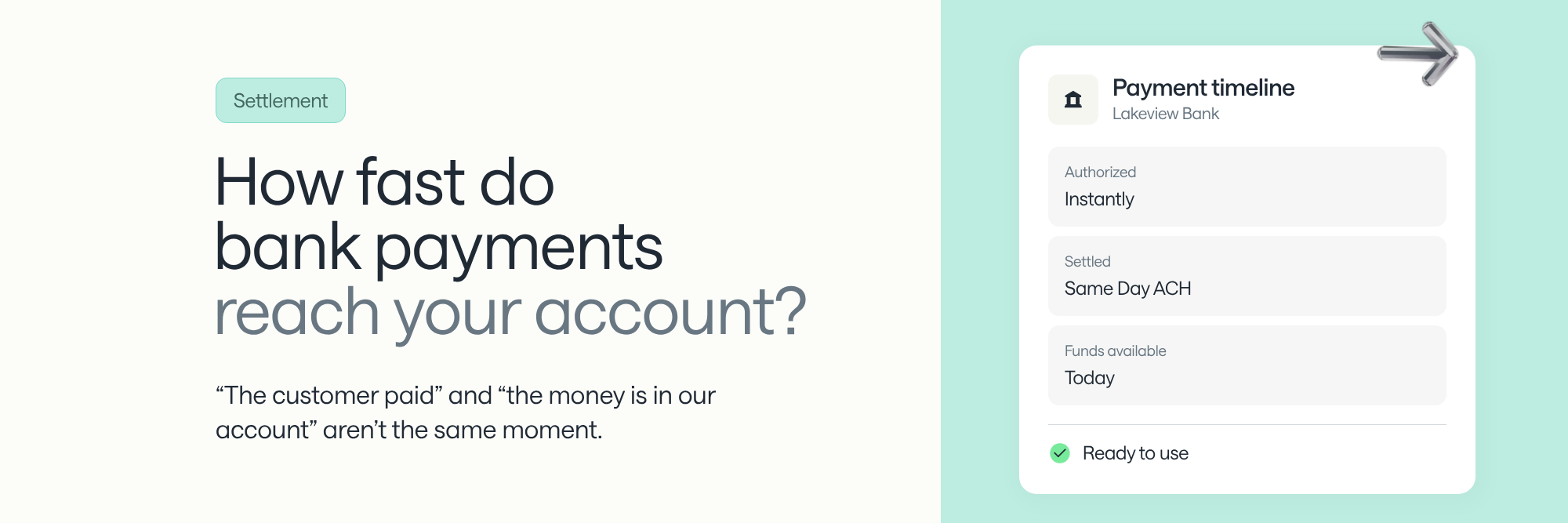
Authorization is the customer’s approval, settlement is money moving between banks, and funds availability is the moment the business can spend it.
For an ACH debit, authorization and settlement sit up to a business day apart, and the customer’s bank can still return the payment after it settles. That gap is where return risk lives and where cash flow gets stuck.
Each payment type puts the three clocks in a different place.
Same Day ACH settlement times come from the Federal Reserve’s FedACH processing schedule. Nacha caps Same Day ACH at $1 million per payment, a limit that rises to $10 million on September 17, 2027. Nacha rules also hold a standard ACH debit to settlement no more than one banking day out.
RTP and FedNow carry only payments the payer’s bank sends. To collect over either rail, a business sends a Request for Payment, and the customer approves it in their banking app, as The Clearing House explains. The Federal Reserve runs FedNow every day of the year, including weekends and holidays. To decide which rail each payment should use, see ACH vs. RTP vs. FedNow: which rail should each payment use?
Settlement moves money between banks, and a payment provider sits between the customer’s bank and the business’s bank. Many providers collect payments into their own account and pay merchants out on a schedule, which can be daily, weekly or after a reserve period.
That schedule decides cash flow more than the rail does. A Same Day ACH debit that settles at 1:00 p.m. ET on Tuesday does nothing for a business whose provider pays out on Friday. The business-day calendar adds to the gap, because ACH settles only on business days. A debit submitted Friday evening settles Monday at the earliest, while RTP and FedNow keep running through the weekend.
The delay matters most for platforms that credit balances, such as gaming, trading and fintech apps. Their customers expect deposits to be usable as soon as they pay.
Ask for the timing of each clock in writing, rail by rail. These five questions separate a fast rail from fast money:
For the rest of a provider evaluation, see how to choose a pay by bank provider in the US. For how returns differ by code, see what ACH return codes mean, and which ones cost you most.
Only if the provider also pays out the same day. A Same Day ACH payment settles between banks at 1:00, 5:00 or 6:00 p.m. ET on a business day, but it reaches the business’s account on the provider’s payout schedule. A weekly payout cancels out the faster rail.
No. A guaranteed ACH payment still settles on the ACH timeline, but the provider takes on eligible return risk, so the business can credit the customer before settlement. The guarantee covers only the return types and amounts in the provider’s terms, so check the coverage limit.
A provider holds funds because an ACH debit can still be returned after it settles. The hold covers that return window, and some providers also batch payouts daily or weekly. Ask for the hold period and payout schedule in writing, separately from the rail’s settlement speed.
No. A business can collect over RTP or FedNow only through a Request for Payment, and only when the customer’s bank supports it and the customer approves the request. Payments from other banks fall back to Same Day or standard ACH, which settle only on business days.
A bank payment reaches a US business in seconds over RTP or FedNow, the same business day with Same Day ACH, and by the next business day with a standard ACH debit. The provider’s payout schedule and return coverage decide when that money is usable. Route payments to the fastest rail each customer’s bank supports, submit before the cutoffs, and choose a provider whose payout timing and guarantee terms match how fast your business needs the cash.
Credit customers without waiting for ACH to settle. See how Aeropay Guaranteed ACH works.