How should US marketplaces pay sellers instantly?
Payments
October 23, 2026
|
Aeropay Team

This article was written by the payments nerds at Aeropay. Our goal is to provide you with solid insights to help your business operationalize more efficient, value-focused payments.
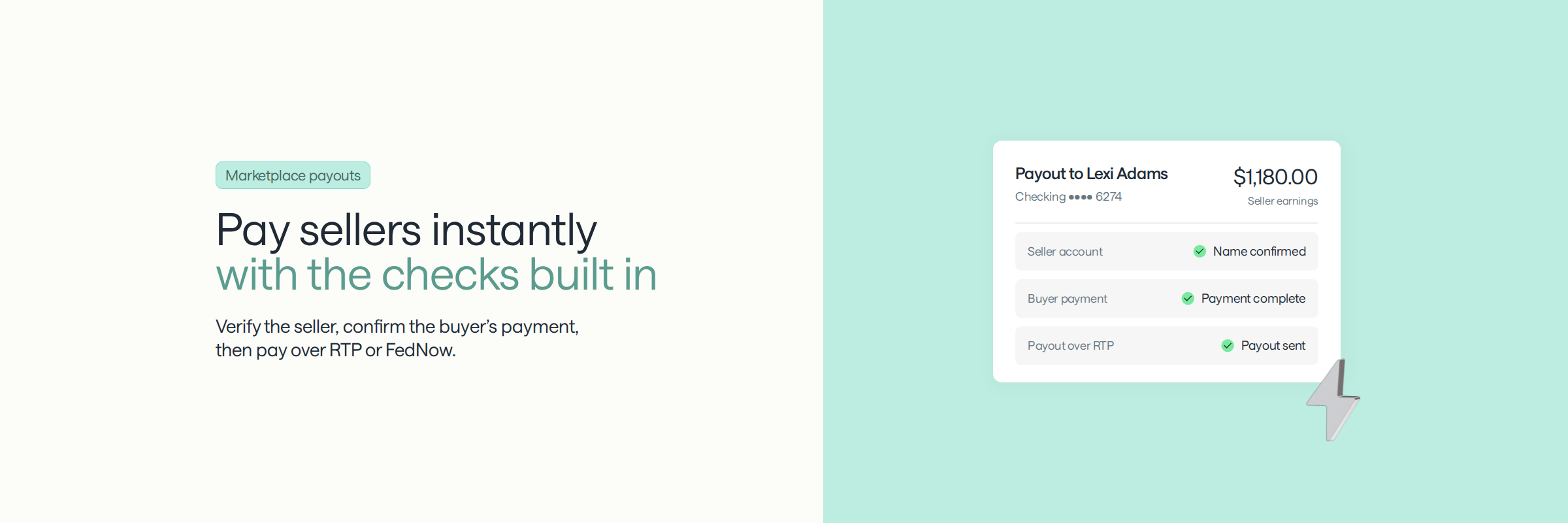
US marketplaces should pay sellers instantly by verifying each seller's bank account at onboarding, releasing the payout only once the buyer's payment is settled or guaranteed, and sending it over RTP or FedNow with an automatic fallback to ACH. The order matters because a real-time payment is final once it leaves, so speed without the checks before it turns every payout into a fraud opportunity.
Sellers and gig workers notice payout speed more than any other part of a platform's payments. It is also where a marketplace takes the most risk, since it pays out money that arrived from someone else.
A marketplace pays thousands of recipients it didn't choose, with money from buyers whose payments haven't finished settling. A business paying its own suppliers knows who they are and pays from its own cash.
Three problems follow from that. The marketplace has to confirm each seller owns the account they gave, or a fraudster redirects someone else's earnings. It has to decide when the buyer's money is safe to pass on, because a buyer's bank payment is returnable after it looks final. And it has to reach every seller's bank, including the ones that can't receive real-time payments.
Run checks at onboarding, at the buyer's payment and at the payout itself. Each stage catches a different failure.
At onboarding, verify the seller's account. Have the seller link their bank through a bank-authenticated connection, which confirms the account is open and returns the owner's name to match against the seller's identity.
At the buyer's payment, decide when the funds are safe. Card payments stay open to chargebacks long after the sale. A bank debit to a consumer account stays returnable as unauthorized for 60 days after settlement (Nacha). A guarantee on eligible buyer payments lets the marketplace release seller funds before settlement.
At payout, recheck the account for large amounts. Confirm the destination account still belongs to the seller and holds no surprises, especially after a seller updates their bank details. Aeropay can check a recipient's real-time balance and verify account ownership before releasing large payouts.
In seconds, for recipients whose bank receives real-time payments, at any hour including weekends. RTP and FedNow both run 24/7/365. Everyone else gets paid by ACH, which lands the same day or the next business day.
That split is why a marketplace needs one payout process that picks the rail per seller. Sending every payout by ACH wastes the speed many sellers' banks can already receive, and sending only real-time payouts leaves some sellers unpaid.
Aeropay routes payouts over RTP or FedNow first and falls back to ACH when the recipient's bank can't receive a real-time payment. The gap between the two rails is large in practice: trading platform Topstep cut trader payout times from 3 days to 9 seconds with Aeropay instant payouts (Topstep customer story).
Speed has to be visible to the seller to count. Status updates by webhook let the platform tell a seller whether their money went instantly or by ACH, which heads off the support ticket.
The best payout provider for a US marketplace verifies sellers before their first payout, ties each payout to the status of the buyer's payment, and routes every payout to the fastest rail the seller's bank accepts. Ask each provider the same questions so the answers compare.
| What to look for | Why it matters for a marketplace | Question to ask the provider |
|---|---|---|
| Seller account verification at onboarding | Stops a fraudster redirecting a real seller's earnings | Does linking confirm account ownership and return the owner's name? |
| Payout release tied to buyer payment status | Decides whether you can pay sellers before the buyer's money settles | Which buyer returns are covered, and up to what limit? |
| Per-seller routing with ACH fallback | Pays every seller at the fastest speed their bank allows | Does a rejected real-time payout retry over ACH automatically? |
| Recheck before large payouts | Catches changed bank details and account takeovers | Can you check balance and ownership on the payout account before release? |
| Seller-facing payout status | Turns speed into fewer support tickets | Which webhooks report a payout sent, switched to ACH or returned? |
Yes. Running buyer pay-ins and seller payouts through one bank payment network keeps one record of every seller's account, verified once, and lets the marketplace reconcile money in and money out in the same place.
| Stage | Split across vendors | One network |
|---|---|---|
| Seller onboarding | Seller links a bank with one vendor; the payouts vendor receives copied details | Seller links once; the same connection is used for payouts |
| Buyer payment | Card or ACH processor, separate from payouts | Pay by bank, with return coverage on eligible payments |
| Payout | Separate payout API and reconciliation file | Same integration, real-time rails with ACH fallback |
| Reconciliation | Matched across two or three reports | One set of webhooks and one portal |
Aeropay handles buyer pay-ins, seller payouts and seller account verification through one connected network, so a seller who links a bank at onboarding gets paid to the same verified account. For the developer side of that setup, see what a bank payment API needs to handle both pay-ins and payouts.
For buyers, bank payments cost less than cards and carry no card chargebacks, though a bank debit can still be returned. For sellers, real-time bank payouts with ACH fallback reach every account. Marketplaces whose buyers expect cards keep them at checkout and pay sellers by bank, since bank payouts avoid card push fees.
The best payout providers for gig platforms verify each worker's bank account at signup, send payouts over RTP or FedNow with automatic ACH fallback, and report every payout's status by webhook. Gig platforms pay out often and in small amounts, so per-payout routing and status matter more than headline speed.
Without a guarantee, the marketplace absorbs the loss or claws the money back from the seller. With a guarantee on the buyer's payment, the provider covers eligible returns up to the agreed limit, which makes it safe to pay sellers before settlement for the payments it covers.
Gig platforms send each payout to the bank account the worker linked and verified at signup, over RTP or FedNow where the worker's bank supports it. When a worker changes bank details, the platform rechecks ownership before the next payout, because changed details are a common route for account takeover.
Book a call to see how Aeropay would run your buyer payments and seller payouts through one integration, with the checks built in.