Is pay by bank a good fit for subscriptions?
Payments
October 29, 2026
|
Aeropay Team

This article was written by the payments nerds at Aeropay. Our goal is to provide you with solid insights to help your business operationalize more efficient, value-focused payments.
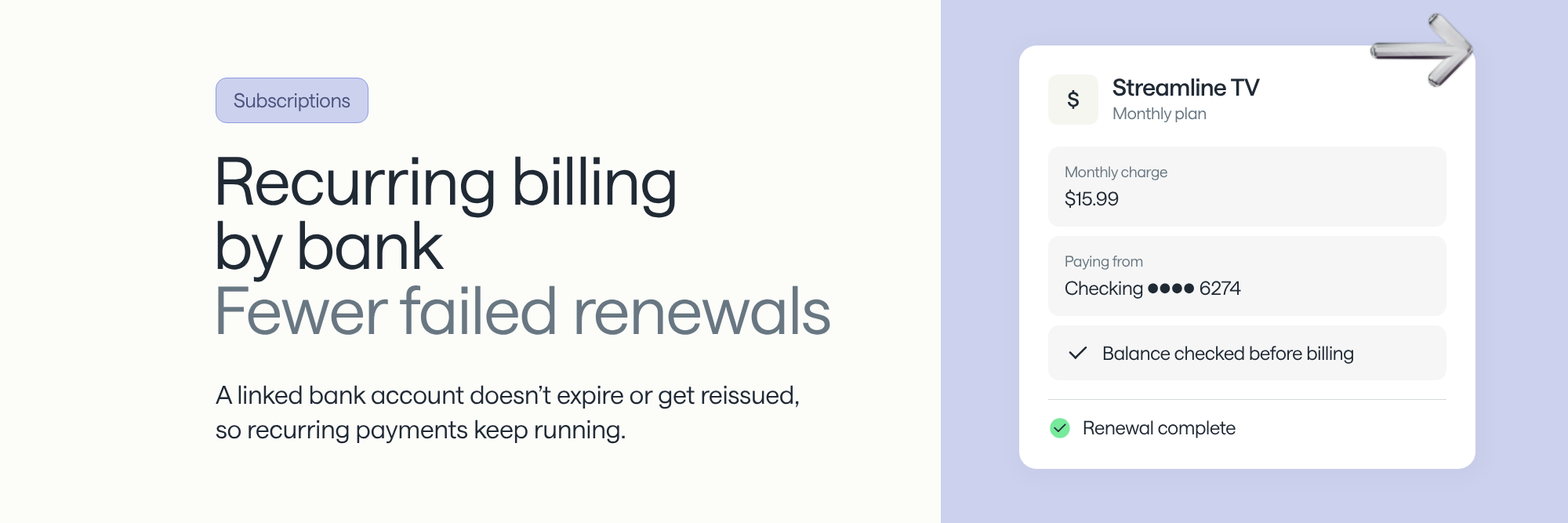
Pay by bank suits US subscription businesses that bill the same customers on a schedule. A linked bank account doesn't expire, get reissued after a breach or hit a credit limit, so recurring payments keep running without the customer updating anything. That removes the card-side causes of involuntary churn. Two risks remain: an empty account on billing day, and a customer disputing a debit later. A balance check before each charge and a clear authorization keep both in check.
Bank billing also costs less per charge. The average swipe fee on Visa and Mastercard credit cards rose to 2.36% of transaction value in 2025, according to the Merchants Payments Coalition, and a bank payment carries no card interchange. For a business that bills the same customers every month, both effects compound.
Cards change on a schedule, and bank accounts rarely do. A card on file goes stale when it expires, when the issuer replaces it after fraud or a breach, or when the customer reaches their limit. Each of those ends a working subscription without the customer choosing to cancel. Bank accounts last far longer: Americans with checking accounts have kept the same one for 19 years on average, according to a March 2025 Bankrate survey.
The bank column has two failure rows of its own, and a business can head off both before the debit runs.
Check the balance right before each scheduled debit. A check at signup says nothing about the account three months later, while a real-time check before each charge catches an empty account before the debit becomes a return.
The first payment carries the most risk, because a new subscriber has no payment history yet. Check it before it clears, and set the billing date to land just after the customer's payday. When a debit still comes back for insufficient funds, Nacha allows up to two more attempts within 180 days of the original settlement. Our guide to recovering a failed bank payment covers how to time them.
Write an authorization the customer can't misread, and bill only within it. The dispute you can prevent is the charge the customer didn't expect.
The authorization should state the amount, the schedule and how to cancel. A debit that departs from those terms, such as a different amount or an earlier date, gives the customer's bank grounds to return it as R11, and the bank has 60 days from settlement to do it. Nacha holds unauthorized returns to 0.5% of a merchant's debits, so an unexpected charge is a compliance risk as well as a churn risk.
Price changes need extra care. Under Regulation E, when a recurring debit will differ from the authorized or previous amount, the customer must get written notice of the amount and date at least 10 days before the transfer (12 CFR 1005.10). If the original authorization named a fixed amount, the safer route is a new authorization before billing the new price. Our guide to stopping failed bank payments covers the other return types.
Ask when a card fails, and give the customer a reason to switch. A failed card charge is the one moment a subscriber has to update their payment method anyway, so offering bank payment there adds no extra step.
Renewal and signup work too. Offer a discount for paying by bank at renewal, and show bank payment first at signup.
Any US provider that can debit a linked account on a schedule, under a stored authorization, supports recurring billing. What separates providers is how they handle the two failure rows in the table above. Look for:
On Aeropay, our risk engine, Guard, scores each payment in real time before funds move and retries failed payments automatically once real-time signals show the funds are available. With Guaranteed ACH, we cover eligible bank-initiated returns, across 50+ return types including insufficient funds, up to the merchant's agreed coverage limit.
Subscribers with a long payment history can move to a lower-cost payment path through our Trusted User Program. Those payments still get a real-time balance check and transaction limits. They sit outside Guaranteed ACH, so the merchant carries their return risk and chooses which customers to move.
Bank payments, for subscriptions billed to the same customers on a schedule, because a linked account doesn't expire and carries no card interchange. Cards still suit customers who want chargeback protection or won't link a bank, so offering both keeps those customers.
No. One authorization covers the schedule and amount it describes, such as a monthly charge of a stated amount. Get a new authorization when the terms change in a way the original didn't cover, such as a higher fixed price or a different bank account.
Yes, with the business or through their bank. Under Regulation E, the bank must honor a stop-payment order given at least three business days before a scheduled debit. Make cancelling with the business easy and clear, so the customer doesn't go to their bank instead.
Talk to our team to see how pay by bank fits into your billing flow.