Open banking vs. screen scraping: what changes for gaming deposits?
Data
October 26, 2026
|
Aeropay Team

This article was written by the payments nerds at Aeropay. Our goal is to provide you with solid insights to help your business operationalize more efficient, value-focused payments.
Open banking connects a player's bank through the bank's own login and a token the bank issues, while screen scraping logs in to the bank's website with the player's password and copies data off the pages. For a gaming deposit, open banking keeps the password with the bank, keeps working when the bank redesigns its site, and on mobile sends the player to their bank's app and straight back to the game.
Screen scraping still sits behind some US bank connections, mostly at banks that haven't opened a direct connection. The method behind your deposit flow decides how often players get through, and the gap shows on the days that matter most.
| What happens | Open banking connection | Screen scraping |
|---|---|---|
| Where the player logs in | The bank's own screen or app | A form inside the gaming app or a provider's window |
| Who sees the banking password | Only the bank | The connectivity provider, which stores or relays it |
| What the provider holds | A token the bank issues for this connection | The player's credentials, reused to log in again |
| What breaks the connection | The player or the bank revoking access | Bank website redesigns, new login steps, password changes |
| Mobile deposit flow | Bank app opens, player approves, game reopens | Player types credentials and answers prompts in a web view |
| Data shared | What the player approves | Whatever the provider reads off the pages |
Gaming deposits arrive in surges around kickoffs and finals, so a connection that fails, fails for many players at once. Across the 39 days of the 2026 World Cup, our daily payment volume averaged 52% above May 2026, and on the Final we moved 73% more volume than on an average tournament day.
A scraped connection breaks when a bank changes its login page or adds a security step. Every player at that bank finds out at the same moment: when they try to deposit before a game. Scraped logins also draw extra security prompts, because the bank sees an unfamiliar system signing in as the player.
For the mechanics of scraping itself and its security risks, see our explainer on API-based bank connections and screen scraping.
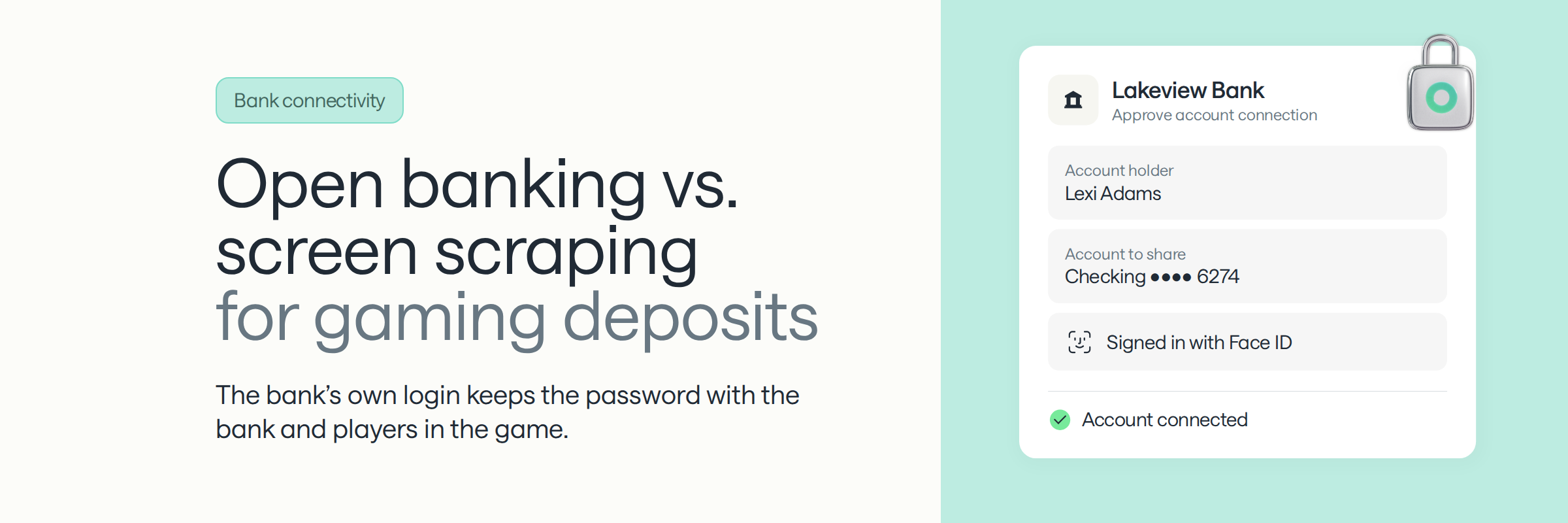
With open banking, the player approves the connection in an app they already trust; with screen scraping, they type their banking password into a form inside yours. On mobile, the open banking flow takes five steps.
A scraped flow keeps the player inside a web view the whole time. They type a username and password they rarely use, answer whatever one-time-code or security question the bank sends, and wait while the provider logs in on their behalf. Each of those steps is a place to drop the deposit.
No password is shared with the gaming platform or with us in the open banking flow. We keep mobile players inside the app during deposits with deep linking and app-to-app bank authorization.
A bank-authorized connection cuts mobile drop-off, survives bank website changes, and returns the data a real-time deposit decision runs on. We connect through bank-authorized connections wherever the bank supports them, which is where each of these gains comes from.
Mobile drop-off. The player approves in their banking app with the login they use every week, instead of recalling a password for a form they've never seen. The step most likely to lose a first deposit becomes a single tap and a face scan.
Broken connections. A token keeps working when the bank redesigns its website, so a Saturday site update doesn't take down every player at that bank. When a token does expire or gets revoked, Aerosync's reconnection flow restores it without making the player link from scratch.
Deposit decisions. The approved connection confirms who owns the account and returns a live balance, so the deposit is checked against available funds before it's approved. That check is what keeps insufficient-funds returns from piling up after a busy weekend. For how balance and risk checks fit into the rest of the deposit flow, see how gaming platforms cut failed deposits.
We built Aerosync, our bank-linking product, after running into the limits of existing aggregators, so it was designed for companies that move money.
Those players fall back to another way of linking, so the share of your players' banks on direct connections sets your deposit success more than any headline bank count. Aerosync reaches more than 12,000 US banks and credit unions, and where an open connection isn't available, its manual verification verifies accounts at 98% of US banks without micro-deposits.
Before you choose or renew a provider, put these four questions to it, using your own deposit data:
The US has an industry data standard but no enforceable federal open banking rule. The Financial Data Exchange (FDX) publishes the API standard banks and fintechs use to share financial data with a customer's permission, and we help define US open banking standards through our leadership within FDX.
The federal rule is on hold. The CFPB finalized its Section 1033 Personal Financial Data Rights rule in October 2024, with the first compliance dates set for April 1, 2026, but a federal court in Kentucky enjoined enforcement while the Bureau reconsiders it. On August 6, 2026, the CFPB sent a revised proposal to the White House Office of Information and Regulatory Affairs, one of the last steps before it publishes for public comment.
For an operator, the deciding factor today is the connection mix your provider runs, not the rulemaking calendar.
Yes, though it's shrinking as banks open direct connections. It remains the fallback at banks without one, and the federal rule that would have required banks to offer direct access is on hold. Expect a mix of connection methods behind any provider's bank list for now.
FDX, the Financial Data Exchange, is a nonprofit industry body that publishes a common API standard for sharing financial data with a customer's permission. It sets the standard; it doesn't move money or process payments.
Not always. Players who have already paid any merchant on our network pay without linking a bank again, which matters in gaming, where players hold accounts on several platforms. Providers without a shared network ask each player to link at every new platform.
Send us your top deposit banks, and we'll show which connect app-to-app and how the rest are handled. Book a demo