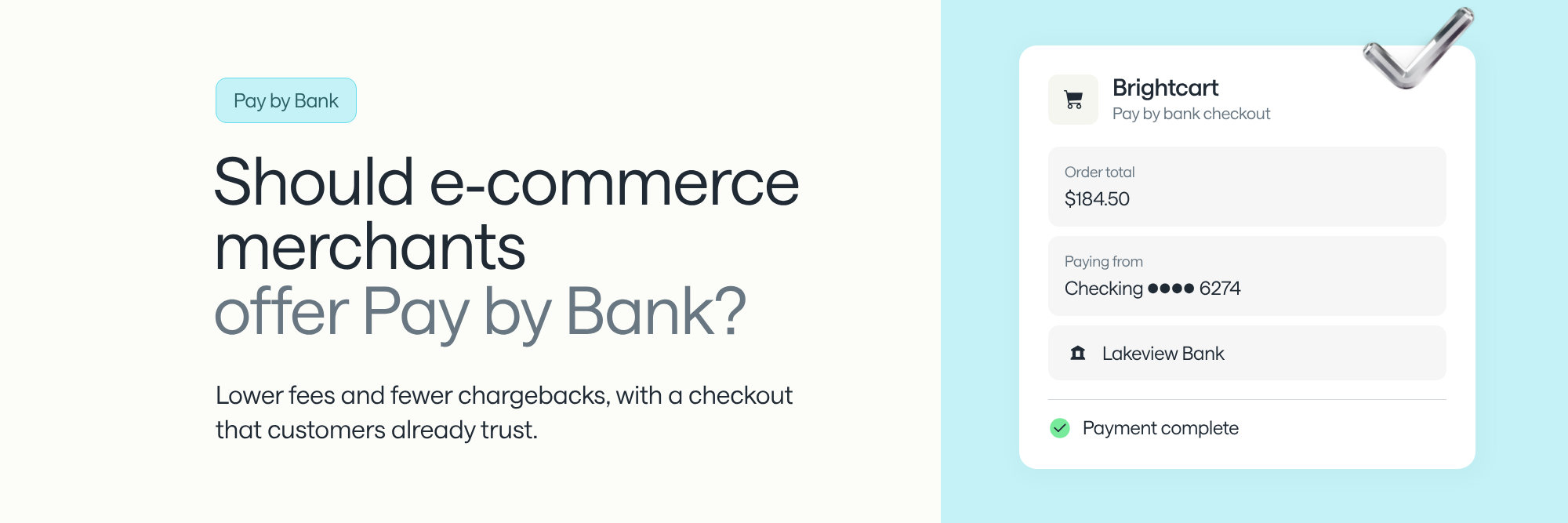
Should e-commerce merchants offer pay by bank?
Payments
October 27, 2026
|
Aeropay Team

This article was written by the payments nerds at Aeropay. Our goal is to provide you with solid insights to help your business operationalize more efficient, value-focused payments.
US e-commerce merchants should offer pay by bank when card fees are a large share of their costs, their orders are large or their customers buy repeatedly. Pay by bank skips card interchange, has no card credit limit to block large orders and lets returning customers check out without re-entering payment details. It pays off least on small, one-time purchases from customers who won't buy again.
Cards stay at checkout. Pay by bank sits beside cards and wallets, and you decide how hard to steer customers toward it.
Four signals predict whether moving volume to bank payments is worth the integration. The more of them your store shows, the faster the work pays back.
| Signal | Why it matters | What to check in your data |
|---|---|---|
| Card fees are a top-three cost | Every dollar moved to bank payments skips card interchange | Total card processing cost as a share of revenue |
| Average order is large | Card fees are a percentage, and large orders hit card limits and fraud filters | Share of orders large enough to hit card limits or fraud declines |
| Customers buy more than once | The customer links a bank once, and every later order skips payment entry | Repeat purchase rate within 12 months |
| Chargebacks hurt margin | No card chargebacks. Disputes come back as ACH returns, with 60 days for unauthorized debits | Chargeback rate and dispute fees per month |
The cost case is the easiest to size. US businesses paid a record $198.25 billion in credit and debit card swipe fees in 2025, according to the National Retail Federation. The pay by bank vs. credit cards breakdown works through the fee math by order size.
Returning customers pay with a single confirmation, because their bank is linked from the first purchase. There's no card number, expiry date or billing address to type, and repeat speed is where bank payments beat cards most clearly.
The first payment carries the effort. The customer picks their bank, logs in on the bank's own screen and approves the connection. Every later purchase is one confirmation at checkout.
A pay by bank network carries that speed across stores. Aeropay recognizes returning users, including anyone who has already paid an Aeropay merchant, so they pay without linking a bank again. A shopper who paid at another store on the network last month arrives at yours with their bank already linked.
For first-time buyers, the bank login is the step to keep short. A customer who abandons it never reaches the faster repeat checkout.
High-ticket stores benefit most because a bank payment has no credit limit. With a real-time balance check, a large order is approved against the money in the customer's account.
A $4,000 furniture order that a card issuer declines for exceeding a limit or tripping a fraud rule goes through as a bank payment when the balance covers it and the payment passes the provider's risk checks.
Percentage-based card fees also scale with the ticket. A store with a high average order value pays the most interchange per order, so it saves the most per order when that volume moves to bank payments. Pay by bank through Aeropay costs up to 50% less to process than cards.
Large bank payments carry return risk until they settle, so a return guarantee matters more as tickets grow. A guarantee lets you release the order before the payment settles. Before relying on one, ask which return types it covers and how the coverage limit is set, because a handful of large returns uses up a limit as fast as hundreds of small ones.
Pay by bank makes the least sense on small, one-time purchases from customers who won't return. A $15 impulse order doesn't save enough in fees to justify asking a first-time customer to link a bank, and that customer never reaches the faster repeat checkout.
Stores with that profile still add pay by bank for their large or repeat orders and leave cards as the default. The decision is which customers to steer toward bank payments.
Adding pay by bank takes one integration that runs next to your current card processor. Pay by bank sits beside cards and wallets at checkout, so you keep your provider and your checkout flow.
If your provider recognizes customers from other stores, confirm your integration runs that returning-customer step. It's the step that brings a shopper's linked bank into your checkout. Our guide to choosing a pay by bank provider covers what else to ask before you sign.
Where pay by bank shows up at checkout does more for adoption than the integration itself. Customers pick it when the checkout tells them what they get for choosing it, whether that's a lower price, faster refunds or rewards. Account creation is a good second moment to ask, because a customer who links a bank at signup starts their next order already connected. And if uptake starts slow, try another placement before you write off the method.
Yes, when the checkout explains the bank login. Customers log in on their own bank's screen to connect the account, so the store never sees their banking password or a reusable card number. Trust grows when the checkout says what happens next and what the customer gets for choosing it.
The customer's bank sends it back as an ACH return. Returns for insufficient funds or a closed account come back within 2 banking days, according to EPCOR's return reason code guide. The money comes out of the merchant's account unless a return guarantee covers it.
The refund goes back to the customer's linked bank account. It arrives in seconds over RTP or FedNow when the customer's bank receives real-time payments, and by ACH when it doesn't.
Yes. Linked bank accounts don't expire or get reissued like cards, so recurring payments keep running without new payment details. The failure to plan for is a balance that's short on billing day, which a balance check before each debit catches.
Run your card volume through our pay by bank savings calculator to see what moving it to bank payments would cut from your processing costs.