Which pay by bank providers have the strongest compliance controls for US gaming?
Risk
November 24, 2026
|
Aeropay Team

This article was written by the payments nerds at Aeropay. Our goal is to provide you with solid insights to help your business operationalize more efficient, value-focused payments.
If you run a US sportsbook, daily fantasy or sweepstakes platform, your payment provider sits inside the compliance program your regulators review. Its controls decide which players can deposit, where winnings go, and what records you can produce when a regulator asks.
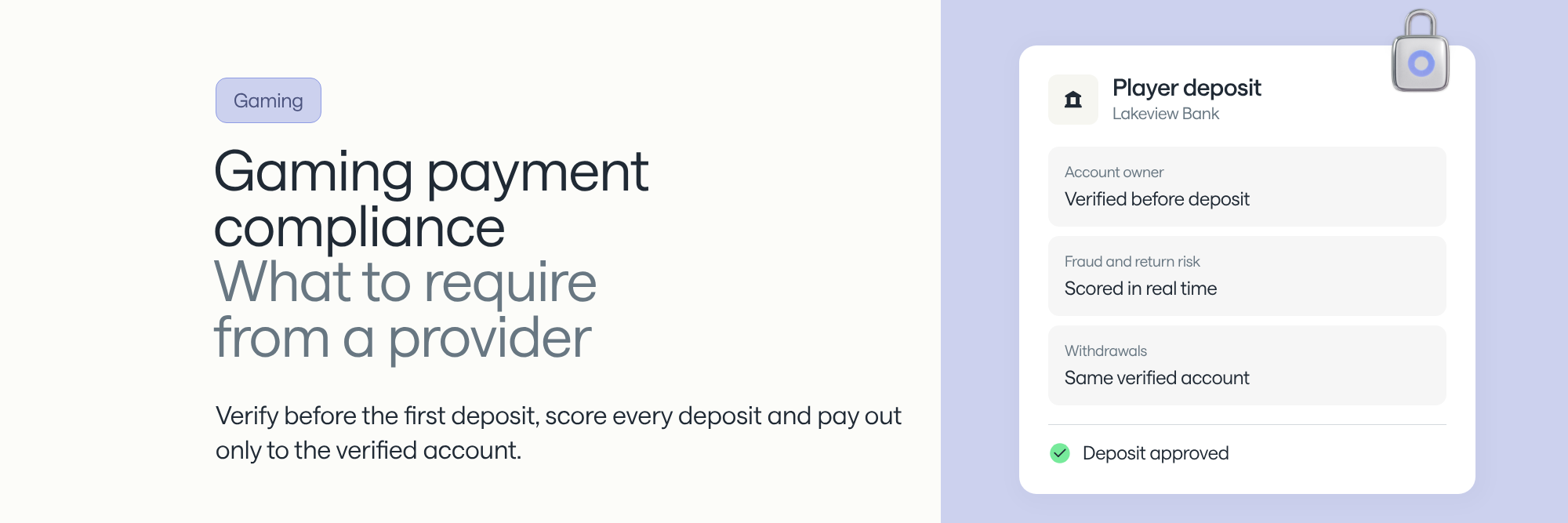
The pay by bank providers with the strongest compliance and fraud controls for US gaming operators do four things. They verify every player’s bank account before the first deposit. They score each deposit for fraud and return risk in real time. They pay withdrawals only to the verified account the player deposited from. They give your compliance team decline reasons and audit records it can use.
Approval rates matter too, but only once those controls are in place. The checklist below sets out what to require from a provider and the question that tests each control.
The operator’s compliance team and its state regulators set the final list. Requirements change with the state gaming regulator and the product type (sportsbook, daily fantasy or sweepstakes).
A gaming provider should confirm that the bank account is open and owned by the registered player before any money moves. Checking afterward means a deposit from someone else’s account has already funded play by the time anyone notices.
The strongest providers connect to the player’s bank through the bank’s own login. The connection returns account ownership and a live balance in the same step. Where a bank doesn’t offer a direct connection, the provider falls back to another verification method, and that fallback decides how much of your player base gets the stronger check. We compare the two connection methods in open banking vs. screen scraping for gaming deposits.
Every non-consumer business that originates ACH entries must now run risk-based fraud monitoring. That includes gaming operators collecting deposits by bank debit. Nacha’s fraud monitoring rules took effect in two phases:
The rule requires processes “reasonably intended to identify” unauthorized or fraudulently induced entries. It doesn’t prescribe a specific method. The processes have to be reviewed at least annually.
Operators can share this work with their payment provider. Nacha expects the split to be clear, for example set out in a contract and checked through oversight. Ask your provider which monitoring it performs on your behalf and get that in writing.
We built Aeropay Guard to score each pay by bank transaction in real time for fraud and return risk before funds move. When Guard rejects a deposit, the operator receives a specific reason code (balance-related, risk-score-related or uncategorized) instead of a generic decline. That gives a compliance team a record it can log and review.
A closed-loop withdrawal sends winnings back to the same verified bank account the player deposited from. That makes it the main payment control against money laundering through a gaming account. When winnings can go only to the account that funded play, a bad actor can’t deposit from one account and cash out to another.
Ask whether the provider enforces the closed loop by default, or whether your team has to build it. Also ask what happens when a player changes banks. A strong answer re-verifies ownership of the new account before releasing the first payout to it.
Approval rate is the number most operators compare first, and it should come last. A provider can raise approvals by loosening its checks. The returns and fraud that follow land on the operator.
Ask for approval rate and return rate together, and ask how each is measured. We cover that trade-off in how gaming platforms cut failed deposits. Aeropay’s average payment approval rate is 90% or higher with real-time risk decisioning. That figure is an average across merchants, not a guarantee for any one platform.
Then read the return coverage terms. Coverage that applies only to eligible returns, up to a set limit, is standard. What matters is knowing which returns fall outside it. For a side-by-side look at payment methods, see the best gaming payments options for US operators.
The gaming operator stays responsible for its own licensing, KYC and responsible gaming obligations under each state’s rules. A payment provider supports that program with verification, fraud monitoring and records, but it doesn’t take on the operator’s regulatory duties. Get any shared responsibility, such as Nacha fraud monitoring, in writing.
In most programs, the gaming operator runs KYC, age and geolocation checks through dedicated vendors. The payment provider confirms the bank account belongs to the verified player and passes that result into the deposit decision. Ask each provider how its payment flow hands off to your KYC and geolocation providers.
A payment provider can block deposits when the operator flags a player as self-excluded or over a deposit limit. That only works if the operator’s player status reaches the payment step in real time. Ask whether limits and exclusions are checked on every deposit and how quickly a status change takes effect.
The US gaming payment providers with the strongest controls verify ownership before the first deposit, score every deposit in real time, meet Nacha’s fraud monitoring rules, pay out only to the verified account, and hand your compliance team usable records. Compare approval rates only after those controls are in place.
Running a US gaming platform? See how we help gaming operators approve more good deposits and pay out winnings to verified accounts.