What payment setup does a marketplace need?
Payments
November 2, 2026
|
Aeropay Team

This article was written by the payments nerds at Aeropay. Our goal is to provide you with solid insights to help your business operationalize more efficient, value-focused payments.
A US marketplace needs five payment capabilities: collecting buyer payments, verifying and onboarding sellers, holding and splitting funds between the platform and sellers, paying sellers out, and reconciling every payment and payout. Bank payments can cover both ends of that stack, with pay by bank to collect from buyers and real-time bank payouts to pay sellers, through one integration.
A store has one flow of money: customers pay, the business gets paid. A marketplace has at least three. Buyers pay in, the platform keeps its fee, and sellers, hosts, drivers or creators get paid out. Each flow carries its own risk, and the gaps between them are where marketplaces lose money and seller trust.
Each layer handles one step in moving money from buyer to seller, and each one fails in its own way.
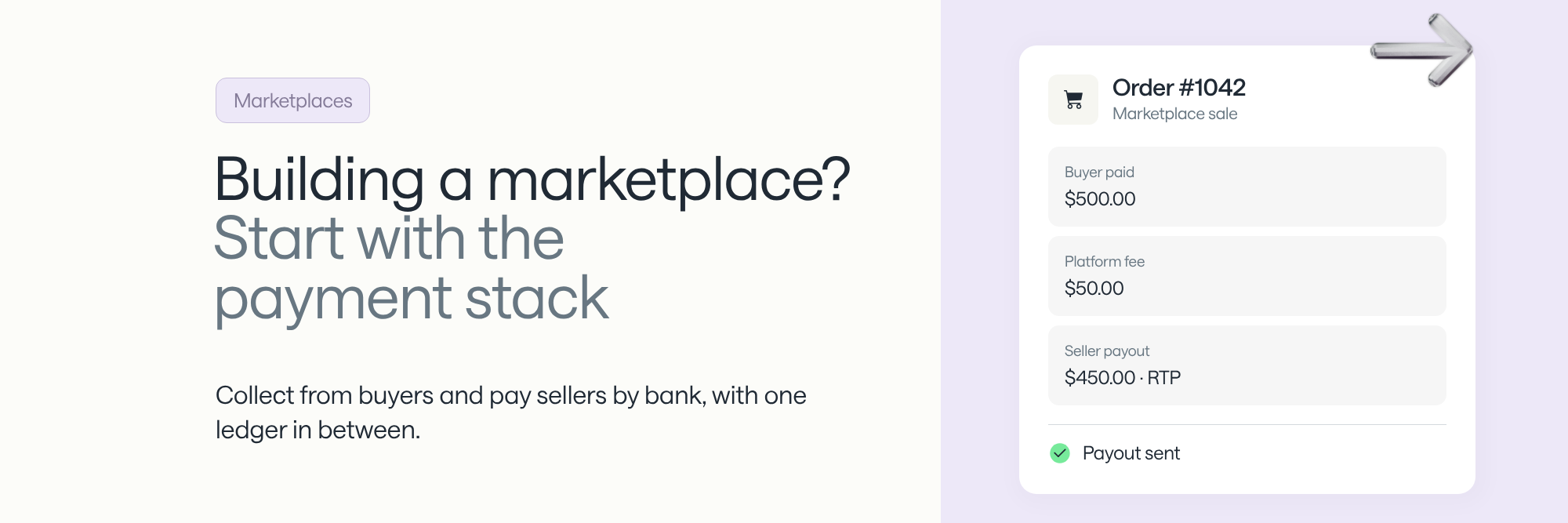
Splits and reconciliation break first because they sit between two money movements that often run on different systems. Say a buyer pays $500, the platform keeps a $50 fee, and the seller is owed $450. That split exists only in the platform's ledger until the payout goes out. Every refund, return or partial payout then has to be traced back to the pay-in that funded it.
When pay-ins and payouts run through separate providers, that tracing happens across two or three reports, by hand. When they run through one integration, each payout ties to the pay-in behind it, and status updates arrive by webhook as payments settle, return or pay out. Merchants can track every Aeropay payout's status in real time through webhooks and the Aeropay merchant portal.
How funds sit between pay-in and payout also decides whether money transmission rules apply to the platform. Have counsel review that structure before launch.
Whether a marketplace needs a money transmitter license depends on whether the platform holds or controls buyer funds before paying sellers. A marketplace that receives buyer money into its own account and later pays sellers can fall under state money transmission rules. Many marketplaces instead route funds through a licensed payment provider's structure. Confirm your model with counsel before launch.
Split payments divide one buyer payment between the platform's fee and the seller's earnings. The platform collects the full amount, records each party's share in its ledger, and sends the seller's share as a payout. The split is a ledger entry; money moves when the payout goes out.
Yes. When a seller links a bank account to get paid, the platform can debit that same verified account for fees, with the seller's authorization. One linked account then handles earnings and charges, so the platform keeps no second set of payment details on file.
A marketplace needs pay-ins, seller verification, funds splitting, payouts and reconciliation, and the gaps between those layers are where it loses money. Bank payments cover both ends of that stack. Running pay-ins and payouts through one provider keeps the ledger in one place and the return risk contained.
Building a marketplace? See how Aeropay runs buyer payments and seller payouts through one integration.