What is the best way to accept high-value payments?
Payments
November 23, 2026
|
Aeropay Team

This article was written by the payments nerds at Aeropay. Our goal is to provide you with solid insights to help your business operationalize more efficient, value-focused payments.
If you run a US business that sells furniture, jewelry, vehicles, equipment or tuition, or takes large account deposits, one order can run to thousands of dollars. At that size, the payment method you offer at checkout decides how much of the sale you keep and how much risk you carry until the money settles.
For most US businesses, pay by bank is the best way to accept high-value payments online. Bank payments carry no card interchange, so a flat or capped provider fee stays level as the ticket grows. Verified accounts and guaranteed or real-time settlement keep return risk low. Cards suit buyers who want rewards or financing; wires suit large B2B invoices.
Card pricing comes from Helcim's 2026 data reported by The Motley Fool. The Same Day ACH limit comes from Nacha, the 60-day unauthorized-return window from the Nacha Operating Rules, RTP limits and finality from The Clearing House, and wire finality from the Federal Reserve. For which rail fits which payment, see ACH vs. RTP vs. FedNow: which rail should each payment use? For how fast each rail settles, see How fast do bank payments reach a business account?
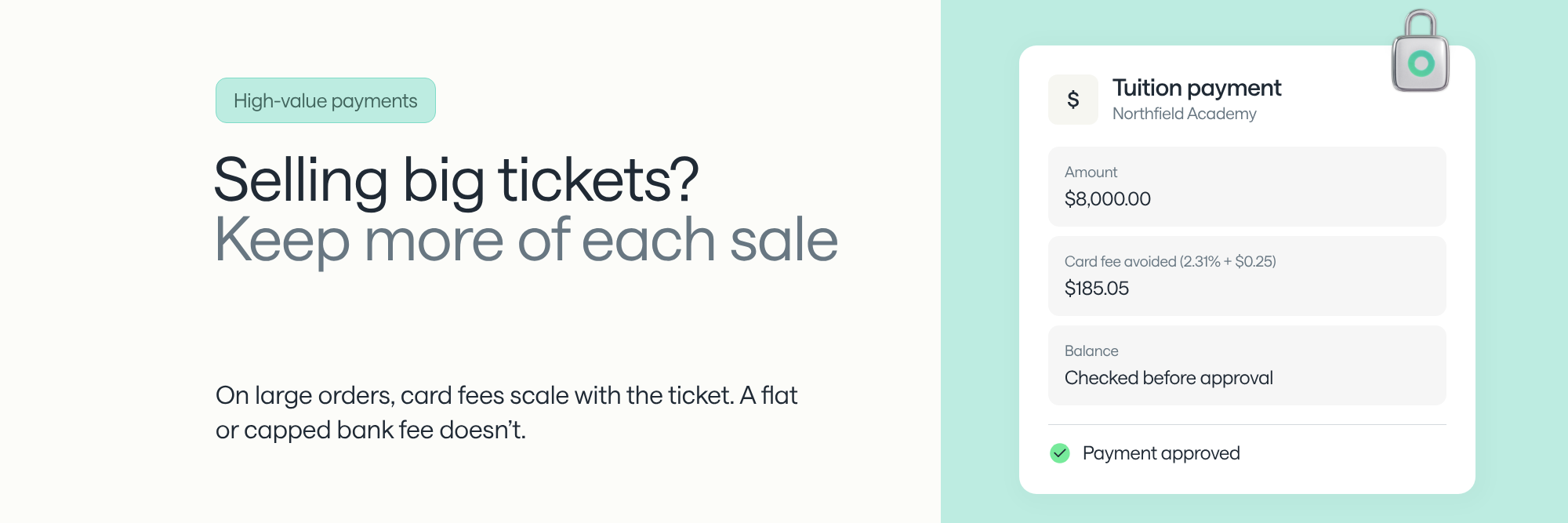
Card fees hurt most on large tickets because they are charged mostly as a percentage of the sale. Online Visa, Mastercard and Discover payments cost merchants about 2.31% plus $0.25 each under interchange-plus pricing, according to Helcim's 2026 data reported by The Motley Fool. That is about $1.17 on a $40 order and about $185.05 on an $8,000 tuition payment, before any chargeback. US merchants paid a record $198.25 billion in card processing fees in 2025, according to Nilson Report figures in the same article. Pay by bank through Aeropay costs up to 50% less to process than cards. Bank payments carry no card interchange, so the saving grows with the ticket when the provider charges a flat or capped fee. A percentage fee climbs the same way card fees do. For how providers price each model, see How much do pay by bank providers charge per transaction? For a fee-by-fee comparison with cards, see Pay by bank vs. credit cards: which costs merchants less?
The main risks of a large bank payment are insufficient funds, unauthorized-debit claims, fraud on a first order and shipping before the money settles. Each one has a specific control.
We built Aeropay Guaranteed ACH for that last problem. With Aeropay Guaranteed ACH, merchants can credit customers right away instead of waiting days for ACH to settle. Aeropay Guaranteed ACH covers eligible bank-initiated returns, across 50+ return types including insufficient funds, up to the merchant's agreed coverage limit. For what that coverage includes, see how guaranteed ACH works.
Keep cards for buyers who want rewards points, buy now, pay later or card financing, and keep wires for large B2B invoices where the buyer's finance team prefers them. For most online high-ticket consumer sales, show pay by bank next to cards and explain the saving in one line, so buyers get a cheaper option without leaving checkout. For the signals that show pay by bank will pay off for an online store, see Should e-commerce merchants offer pay by bank?
Yes, pay by bank is safe for large purchases when the provider verifies account ownership, checks the balance in real time and scores the payment for fraud before approving it. The buyer logs in through their own bank, so no card number or bank password is shared with the merchant. See how pay by bank stays secure for US businesses.
Yes, each bank payment rail caps the size of a single payment. Nacha caps Same Day ACH payments at $1 million each, and the RTP network allows up to $10 million per payment. The buyer's bank and your provider often set lower limits, so confirm both before you quote a large order.
Yes, a consumer can dispute an ACH debit as unauthorized and have it returned for up to 60 days after it settles, under the Nacha Operating Rules. Instant payments on the RTP network are final once settled, so there is no network return or chargeback process for them.
For high-value online payments, pay by bank keeps the fee from scaling with the ticket when the provider charges a flat or capped rate, and it keeps return risk low when the account is verified and the payment is guaranteed or settled instantly.
Selling high-ticket items? Accept large bank payments and credit customers right away with Aeropay Guaranteed ACH.